
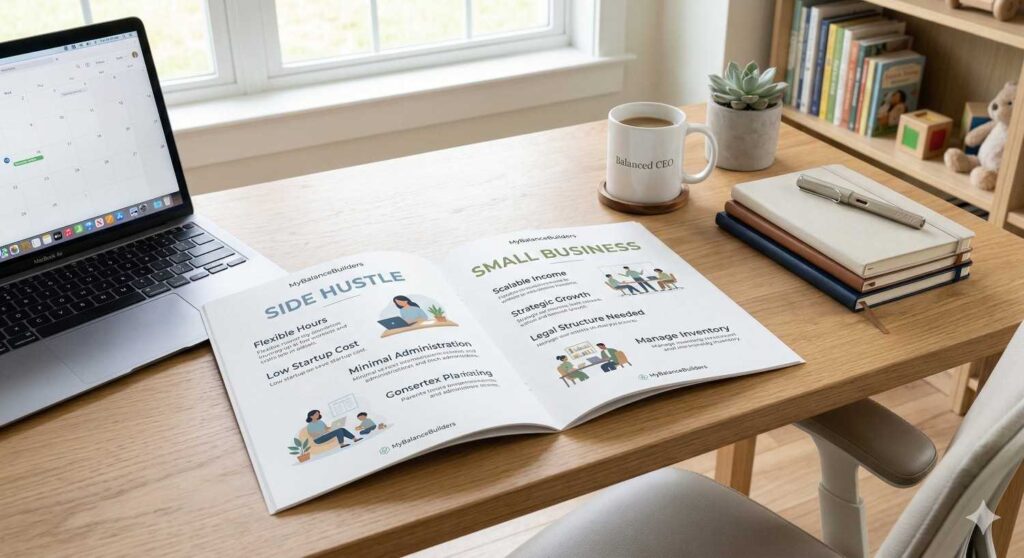
Side Hustle vs. Small Business: What's the Difference? (And Which One Fits Your Life?)
Ever catch yourself Googling “how to make extra money” at 11 PM while the kids are finally asleep?
Yeah. Me too.
And somewhere between the search results and the overwhelm, you probably ran into two phrases that sound the same but mean very different things.
Side hustle vs. small business.
You hear them everywhere. On podcasts. On TikTok. In those ads that promise you’ll make $10K a month while sipping coffee in your pajamas.
But here’s the thing — understanding the difference between a side hustle and a small business isn’t just a vocabulary exercise. It changes everything about how you spend your time, your money, and your energy.
And when you’re a busy parent trying to build income around school runs and bedtime routines? That difference matters even more.
So let’s break it down. No fluff. No jargon. Just the stuff that actually helps you move forward.
Side Hustle vs. Small Business — The Real Difference
Let’s keep this simple.
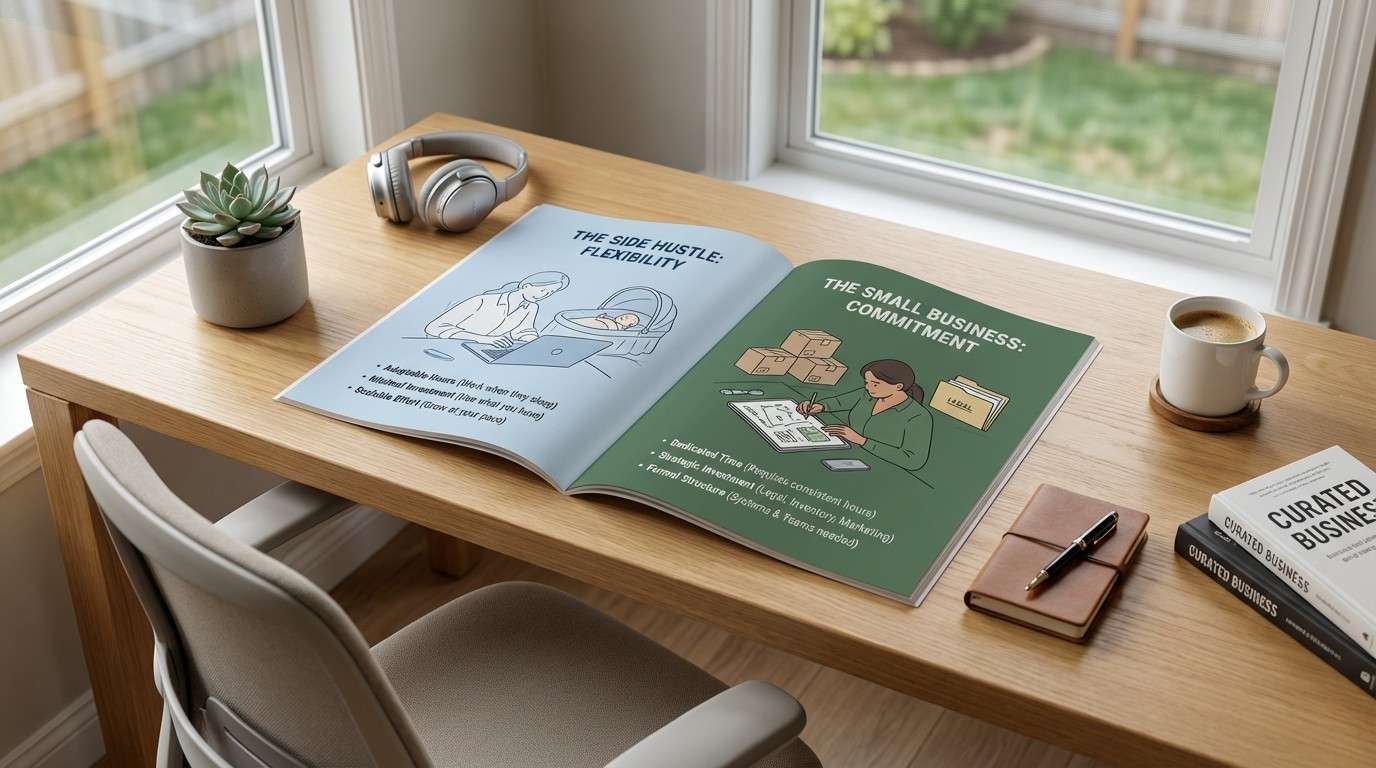
A side hustle is something you do in addition to your main source of income. It stays on the side. You work on it in your spare time — early mornings, late nights, lunch breaks, weekends.
A small business is something you build as your primary focus. It requires serious investment of time, money, and mental energy. It’s not a side thing. It’s the thing.
Here’s a quick way to think about it:
- Time commitment. A side hustle fits around your life. A small business becomes your life. According to a Hiscox survey, side hustlers who eventually went full-time worked an average of 20 hours per week on their hustle before making the leap. That’s a lot of nights and weekends.
- Investment level. Side hustles are low-cost to start. Many require nothing more than a laptop and Wi-Fi. Small businesses often need formal structures, dedicated accounts, legal filings, and ongoing expenses.
- Income expectation. The average side hustler earns about $530 per month. That’s not life-changing money on day one — but it compounds. A small business aims for enough revenue to replace your full-time income entirely.
- Legal structure. A side hustle usually runs as a sole proprietorship by default. However, as income grows, you may want to consider an LLC or S Corp for tax benefits and liability protection. The U.S. Small Business Administration recommends opening a dedicated business account as soon as you start earning.
- Mindset. A side hustle is an experiment. A small business is a commitment.
Neither one is better. They’re just different.
The real question isn’t which one is “right.” It’s which one fits your life right now.
When Does a Side Hustle Become a Business?
This is the question nobody talks about enough.
You start selling digital products on the side. Then you get a few sales. Then a few more. Then you’re making $500 a month. Then $1,000.
At some point, you look up and think: Wait — is this a business now?
Here are the signs your side hustle is crossing the line:
- You’re earning consistent monthly revenue. Not a one-time spike. Regular, predictable income. Even $300–$500 per month consistently is a signal.
- You’re reinvesting money back into it. Buying tools. Paying for hosting. Running ads. Upgrading your systems. That’s business behavior.
- You’re thinking long-term. You’re not just making a quick buck. You’re building something. Creating content. Growing an audience. Planning product launches.
- People are finding you. Organic traffic is coming in. Pins are getting clicks. Blog posts are ranking. You didn’t just get lucky — your systems are working.
- It’s taking real time. If you’re spending 10+ hours a week on it, you’re operating at business level — even if you haven’t filed the paperwork yet.
The truth is — a lot of the best small businesses started as side hustles. Over 250,000 new U.S. businesses each month begin that way. The transition doesn’t have to be dramatic. It can be gradual.
You don’t have to quit your job tomorrow. You just have to keep showing up today.
The 30-Minute Side Hustle Framework
Every strategy on MyBalanceBuilders follows one rule: if you can’t make progress in 30 minutes, it doesn’t belong here.
Here’s what a real, sustainable side hustle looks like when you’re working in 30-minute blocks:
Week 1–2: Pick Your Path (30 min/day)
- Choose a niche you know something about. Parenting hacks. Budgeting. Meal prep. Fitness. Crafts. It doesn’t matter — pick one.
- Set up a free Canva account and choose your brand colors.
- Decide: blog, Pinterest, Instagram, or all three.
- Total time: about 3 hours across the first week.
Week 3–4: Create Your First Content (30 min/day)
- Write one blog post or create 5 Pinterest pins.
- Set up your first content system — batching is key. Create multiple pieces in one sitting.
- Start building an email list with a simple freebie.
- Total time: about 3.5 hours across the week.
Month 2: Build Your Product (30 min/day)
- Create a simple digital product — a checklist, guide, planner, or template.
- List it on a platform like Beacons, Gumroad, or Etsy.
- Start linking your content to your product. Blog post → freebie → paid product.
- Total time: about 7 hours across the month.
Month 3+: Optimize and Grow (30 min/day)
- Review what’s getting traffic. Double down on what works.
- Add new blog posts. Create more pins. Repurpose content across platforms.
- Aim for your first $100 month. Then $300. Then $500.
Similarly, the timeline above isn’t a “get rich quick” plan. It’s a get started right now plan. And it works.
The best part? None of this requires you to show your face. Not once.
Consistency in small blocks beats hustle-culture burnout every single time.
Why Faceless Marketing Changes Everything
Here’s where it gets really interesting.
Most people think building an online business means becoming an influencer. Dancing on Reels. Filming talking-head videos. Building a “personal brand.”
And look — if that’s your thing, go for it.
But for busy parents? That model is broken.
You don’t have time to do your hair, set up ring lights, and film 15 takes of a 30-second video while your toddler screams in the background. (Been there.)
Faceless marketing flips the whole model.
Instead of building around you, you build around your content. Your value. Your systems.
Here’s what that looks like in practice:
- Blog posts that rank on Google and drive traffic 24/7 — no camera required.
- Pinterest pins with text overlays that send readers to your blog and products for months after you create them.
- Digital products like guides, planners, and templates that sell while you sleep.
- Email sequences that nurture and convert — automatically.
For example, one blog post with the right SEO can bring in hundreds of visitors every month for years. One Pinterest pin can drive traffic for 6–12 months. One digital product can sell on autopilot forever.
That’s the power of faceless marketing. It removes the biggest bottleneck from your business: you.
And the research backs it up. In 2026, faceless brands consistently outperform personal brands in terms of scalability, passive income potential, and even exit value. A faceless brand earning $5,000/month can be sold as an asset. A personal brand at the same revenue? Nearly impossible to transfer.
However, faceless doesn’t mean effortless. You still have to create great content. You still have to show up consistently. You still have to build systems.
The difference? You do it in 30-minute blocks. Without a camera. Without showing your face. Without burning out.
Want to see exactly how this works? Our free Faceless Marketing Mini Guide walks you through the entire system — step by step.
Your content should work harder than you do. That’s the whole point.
How to Start Your Side Hustle Today
Alright. Enough theory. Let’s get you moving.
Here’s your action plan — and yes, every single step can be done in 30 minutes or less:
Step 1: Define Your “Why” (10 minutes)
Write down the answer to one question: What would an extra $500/month change for your family?
Maybe it’s paying off a credit card. Maybe it’s finally taking that vacation. Maybe it’s just breathing room.
Your “why” keeps you going when motivation fades. And it will fade. Your “why” brings you back.
Step 2: Choose Your Side Hustle Model (15 minutes)
For busy parents, I recommend starting with digital products + content marketing. Here’s why:
- Low startup cost (often free)
- No inventory, no shipping
- Creates passive income over time
- Works with faceless marketing systems
- Scales without trading more hours for more dollars
Step 3: Set Up Your Foundation (30 minutes)
- Create a free Canva account
- Pick your brand colors and fonts
- Set up a Beacons page or simple landing page
- Write your first blog post outline
Step 4: Create and Launch (30 min/day for 2 weeks)
- Write your first blog post (or outline + draft in two sessions)
- Create 3–5 Pinterest pins linking to it
- Build a simple freebie to start collecting emails
- Share on one social platform
Step 5: Go Deeper
Once you’ve got the basics running, it’s time to level up. Our Ultimate Faceless Marketing Guide gives you the complete playbook — content systems, product creation, email funnels, and Pinterest strategies built specifically for busy parents.
Instead of guessing what works, you follow a proven system. That’s the difference between a hobby and a hustle that actually pays.
The best time to start was yesterday. The second best time is right now — in the next 30 minutes.
Your Next Step
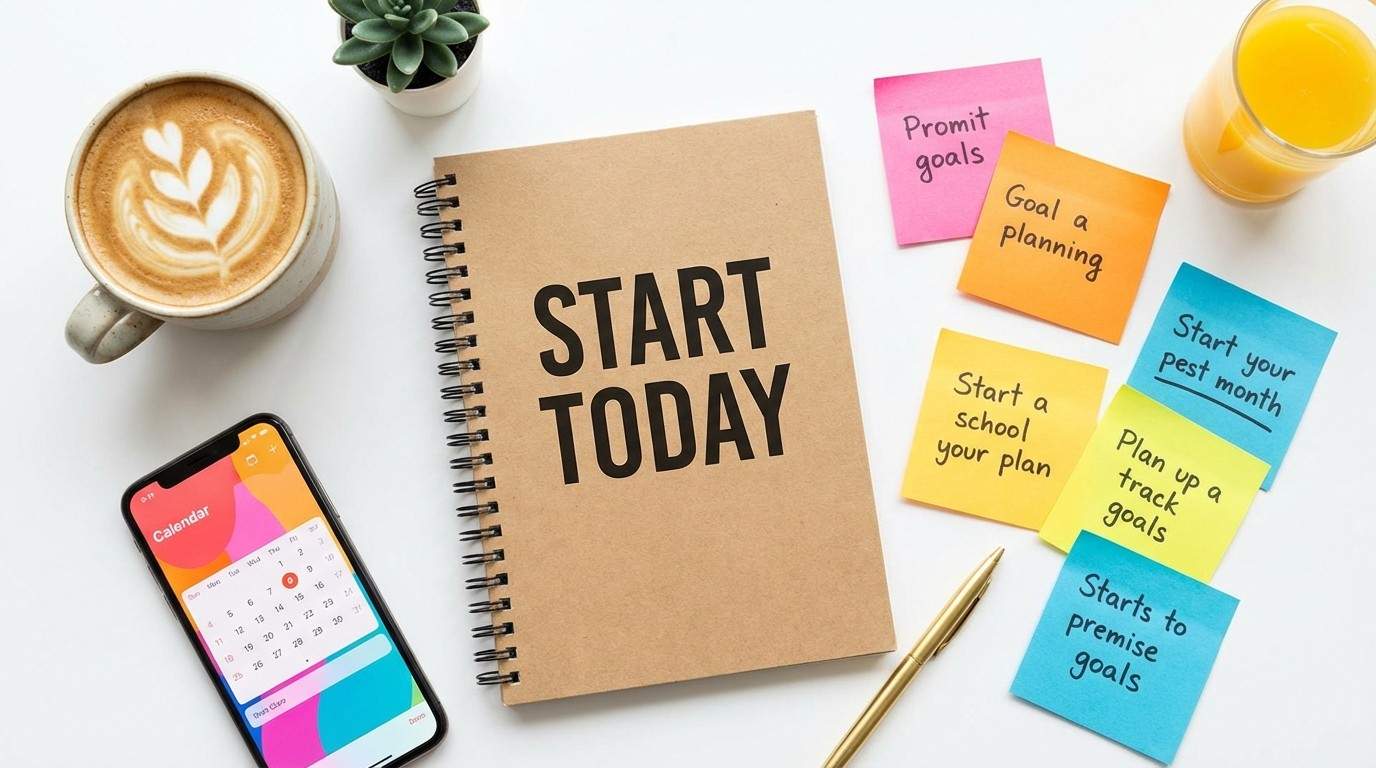
Look — you made it to the end of this post. That tells me something about you.
You’re not just curious. You’re ready.
You don’t need to decide today whether your side hustle will become a small business. You just need to start.
And the easiest way to start? Download our free Faceless Marketing Mini Guide.
It shows you how to build an online income stream without showing your face, without quitting your job, and without spending more than 30 minutes a day.
No complicated tech. No expensive tools. No “hustle until you drop” nonsense.
Just clear, proven steps that fit around your life as a parent.
Because the difference between a side hustle and a small business? It starts with one small step.
And you just took it by reading this far.