
How to Price Digital Products (Don't Make These 5 Mistakes)
What’s the right price for the digital product you just built — and how do you know you’re not leaving money on the table?
This is where most beginners freeze. They’ve created something great. They’re ready to sell. But then they stare at the pricing field and panic.
The truth is… learning how to price digital products correctly is the difference between a product that sells every week and one that collects dust. Get it right, and people buy without hesitation. Get it wrong, and no amount of marketing will save you.
In fact, the biggest mistake isn’t pricing too high. It’s pricing too low. And almost every beginner makes it.
Here are the 5 pricing mistakes that kill digital product sales — and exactly how to avoid each one.
Table of Contents
– Why Pricing Is Where Most Beginners Lose Money
– Mistake #1: Pricing Too Low
– Mistake #2: Copying Competitor Prices Blindly
– Mistake #3: Pricing Based on Time, Not Value
– Mistake #4: Only Offering One Price Point
– Mistake #5: Never Raising Your Price
– The Formula to Price Digital Products Right
– The Cheat Sheet — Pricing Sweet Spots
– Set Your Price and Ship It
Mistake #1 — Pricing Too Low (The $2 Trap)
This is the most common mistake. And it’s the most expensive one.
New creators think: “If I price it at $2, everyone will buy it.” But here’s what actually happens — nobody buys it. Because $2 screams “this isn’t worth anything.”
However, pricing psychology works in reverse from what you’d expect. A product priced at $9 often outsells the same product priced at $2 — because $9 signals value. The buyer thinks “this must be good if they’re charging $9 for it.”
Here’s the rule: if the only way to sell your product is by making it dirt cheap, you either have the wrong product or the wrong positioning. Not the wrong price.
For example, a simple weekly planner priced at $2 will be ignored. That same planner rebranded as “The Busy Parent’s 30-Minute Weekly Planner — Designed for Moms Who Hate Planning” and priced at $9 will sell. Same product. Different positioning. Different price. Different result.
Cheap prices don’t attract more buyers. They attract zero buyers who assume it’s worthless.
Mistake #2 — Copying Your Competitor's Price Blindly
Should you research what competitors charge? Absolutely. Should you copy their exact number? Never.
Here’s why. Your competitor’s price reflects their brand, their audience, their product quality, and their business model. None of those things are yours.
Instead, use competitor prices as a reference range — not a target. If similar products sell for $7-$17, you know the market accepts that range. Where you land within it depends on your product’s unique value.
Similarly, a competitor pricing at $3 might be making a strategic mistake you don’t want to copy. Or they might be using that product as a loss leader to sell something bigger. You don’t know their strategy — so don’t inherit their price.
The 10-minute competitor audit: Search your product type on Etsy or Gumroad. Note the prices of the top 5 results. Find the average. Then price your product 10-20% above that average — and make sure your product description and mockup images justify the premium.
This takes 10 minutes. Do it before every launch.
Competitors are a compass, not a GPS. Use them to find direction — not your exact destination.
Mistake #3 — Pricing Based on Time, Not Value

How long did it take you to create your digital product? An hour? A weekend? Two weeks?
It doesn’t matter. Not even a little bit.
Your customer doesn’t care how long it took you. They care about what the product does for them. How much time does it save them? How much stress does it remove? What problem does it solve?
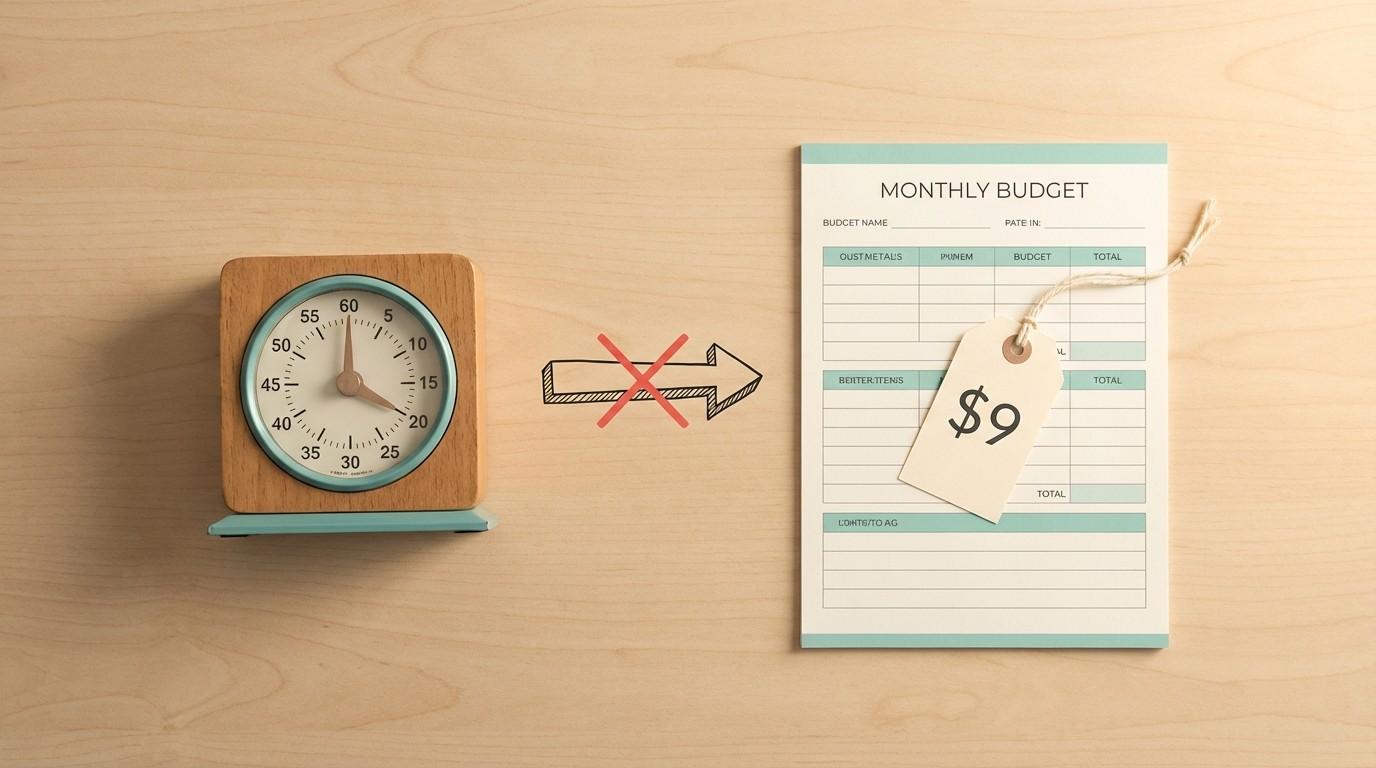
Therefore, a budget tracker you built in 20 minutes can absolutely sell for $9 — because it saves the buyer hours of spreadsheet frustration every month. The value isn’t in your 20 minutes of creation time. It’s in the buyer’s ongoing time savings.
According to Kajabi’s pricing benchmark data, top-performing digital product creators price based on the outcome delivered, not the effort invested. Their products sell more and generate higher customer satisfaction.
Ask yourself: “What is this product worth to the person buying it?” Not “What is this product worth based on how long I spent making it?”
Time is your cost. Value is their price. Never confuse the two.
Mistake #4 — Only Offering One Price Point
If you only sell your product at one price, you’re leaving two entire customer segments on the table.
Here’s what I mean. In any audience, there are three types of buyers:
- The “just trying it out” buyer — wants the cheapest option to test the waters. Willing to spend $5-$9.
- The “give me the best value” buyer — wants the most for their money. Willing to spend $15-$27.
- The “I want everything” buyer — wants the complete package. Willing to spend $37-$67.
On the other hand, if you only offer a $12 planner, you miss the $37 buyer who would have paid triple for a bundle. And you miss the $7 buyer who wanted something smaller to start.
The fix is simple: create three tiers.
- Basic — Single product ($7-$12)
- Bundle — 2-3 related products packaged together ($17-$27)
- Complete — Everything you offer in one package ($37-$67)
Interestingly, most buyers choose the middle option. This is called the “decoy effect” — the basic tier makes the bundle look like great value, and the complete tier makes the bundle look affordable. The middle option wins by design.
If you want to see how to structure these tiers strategically and build a full value ladder for your digital product business, the Digital Product Playbook covers the complete pricing psychology framework.
One price captures one buyer type. Three prices capture all three. It’s not more work — it’s smarter work.
Mistake #5 — Never Raising Your Price
You launched at $9. You’ve sold 50 copies. Reviews are positive. People love it.
So why are you still charging $9?
Most creators set a price on launch day and never touch it again. That’s a mistake. Your product is more valuable now than it was on Day 1 — you’ve got social proof, reviews, and a track record.
Above all, raising your price is the single easiest way to increase revenue without creating a new product, finding new customers, or spending more time. Same product. Higher price. More money per sale.
Here’s a simple price-raising framework that takes 5 minutes:
- After 25 sales: Raise the price by $2-$3. You’ve got social proof now.
- After 50 sales: Raise by another $3-$5. Demand is proven.
- After 100 sales: You should be at 2x your original price. If people are still buying, raise again.
Consequently, a product that launched at $9 and reaches 100 sales should be priced at $15-$19. You’re not gouging anyone — you’re pricing based on proven demand.
A price you never raise is a price you set once and regretted forever.
The Simple Formula to Price Digital Products Right
Forget complicated pricing models. Here’s the formula that works for 90% of digital product sellers:
- Research the market (10 min). Search your product type on Etsy, Gumroad, or Beacons. Note the price range of the top 5 competitors.
- Identify your product’s unique value (5 min). What does your product do that the competitors’ don’t? Specific audience? Better design? More actionable content? That’s your differentiator.
- Price at or above the market average (1 min). If the range is $7-$17, start at $12-$15. Never start at the bottom of the range.
- Create 2-3 tiers (15 min). Bundle your product with related items to offer a basic, bundle, and complete option.
- Plan your first price increase (1 min). Set a calendar reminder: “After 25 sales, raise price by $3.”
Total time: about 30 minutes. That’s one session during naptime. And it sets your pricing foundation for the life of the product.
For the complete pricing system — including pricing psychology, value ladder strategy, launch pricing vs evergreen pricing, and how to price bundles — the Digital Product Playbook has the full chapter-by-chapter breakdown.
Pricing isn’t a guess. It’s a 30-minute research session that determines how much money your product makes for years.
The MBB Pricing Sweet Spots (Cheat Sheet)
Here’s our internal pricing guide at My Balance Builders — based on what’s actually selling across our community:
Checklists and single-page printables: $5-$9
Planners and workbooks: $9-$15
Template packs (10+ templates): $12-$19
Mini guides and ebooks (under 20 pages): $9-$17
Comprehensive guides (20+ pages): $17-$37
Bundles (3+ products): $27-$47
Premium bundles or “Business in a Box”: $47-$97+
As a result, these ranges aren’t arbitrary. They’re based on real sales data, customer feedback, and what converts on Beacons and Etsy for products designed for busy parents.
If you’ve already built your first product and need the full creation-to-pricing-to-launch roadmap, our step-by-step guide on how to create your first digital product in a weekend covers the complete Saturday-to-Sunday timeline.
And if you need product ideas before you even get to pricing, our post on 10 digital products you can make in Canva today covers the 10 most profitable options for beginners.
Bookmark this cheat sheet. Come back to it every time you launch something new.
Set Your Price and Ship It
Here’s what I want you to walk away with today.
Pricing doesn’t need to be perfect on Day 1. It needs to be strategic on Day 1 — and then refined based on data.
The 5 mistakes are real. Avoid them:
- Don’t price too low — $2 screams “worthless”
- Don’t copy competitors blindly — use them as a compass
- Don’t price based on your time — price based on their value
- Don’t offer just one price — create 3 tiers
- Don’t freeze your price forever — raise it after social proof
Follow the 30-minute formula. Set your price. Launch your product. Then let the data tell you what to adjust.
For the complete system — from choosing what to build to pricing it to launching it to scaling it — our passive income ideas for busy parents guide covers the full picture.
Everything you want exists on the other side of fear.
Want to learn how to promote your products without being on camera? Our Faceless Marketing Mini Guide shows you exactly how — from choosing your niche to your first week of content. Free download, no strings.